

I Know Things Now
Or some Main Meanderings on Into The Woods

Recently I called M.C.:
“Nice is different than good, right?”
“Yes?”
“But is nice different than polite? Because I feel like sometimes people who are obsessed with politeness think they are being good but they are just being polite and then they get mad at you for not being nice, when maybe you’re trying to be good but not nice.”
And luckily M.C. has the patience of a saint because she debated this with me while I walked around a H&M, a Paper Source, and the bathroom of The Shops at Columbus Circle.
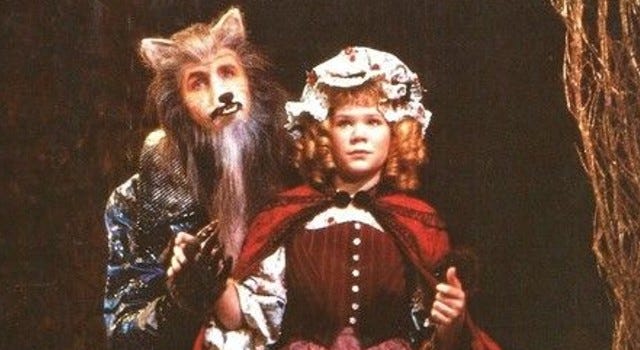
Into the Woods is obsessed with the difference between nice and good. It’s a clear message in a show that has several to choose from, but it is said directly in Little Red’s song “I Know Things Now”:
And take extra care with strangers—
Even flowers have their dangers
And though scary is exciting
Nice is different than good
And I wonder how often we recognize the difference between nice and good. I once had a teacher who assigned a big project; he asked us to define two similar words in relation to one another. There was a list of them. I don’t remember what mine were (I looked for the essay all evening), but two of the words were Cult vs. Religion. And the assignment implored us to look at the nuances of language. To define the words we use, and to understand what we mean when we use them. He gave us the credit that we knew they were different, and often we used them correctly! But defining how we used them and why, was trickier, and thus the assignment.
My current therapist is often on me about how I use words. Do I indulge in something or do I enjoy it? Do I manipulate or do I influence? “You know what I mean,” I say to her, reflexively. “No I don’t,” she responds “explain it to me.”
“Wanting,” in Into The Woods, is simple. All one has to do is simply say---I wish---and then whatever they desire: the festival, the cow, a child. Love, riches, family. Name it and it’s yours. Everafter.
Well at least in the first act it’s that simple.
In the second act they start off wishing for more. More wanting, even though they got everything they supposedly wanted. But they don’t get it this time. Instead they get other things.
And that is what makes Into The Woods hard to talk about.
Because Into The Woods is basically flawless. There is so much to learn from it, there are so many fascinating musical moments that make me wish I’d taken a music theory class in college, it’s---perfect.
But it is also hard to tease one meaning out of it. Hard to tell one story about it. There are so many stories within it! So many messages depending on which one you like best! And on top of that, if you want to learn nothing, you just can! You can learn nothing from Into The Woods and still like the music, it is---dare I say---hummable.
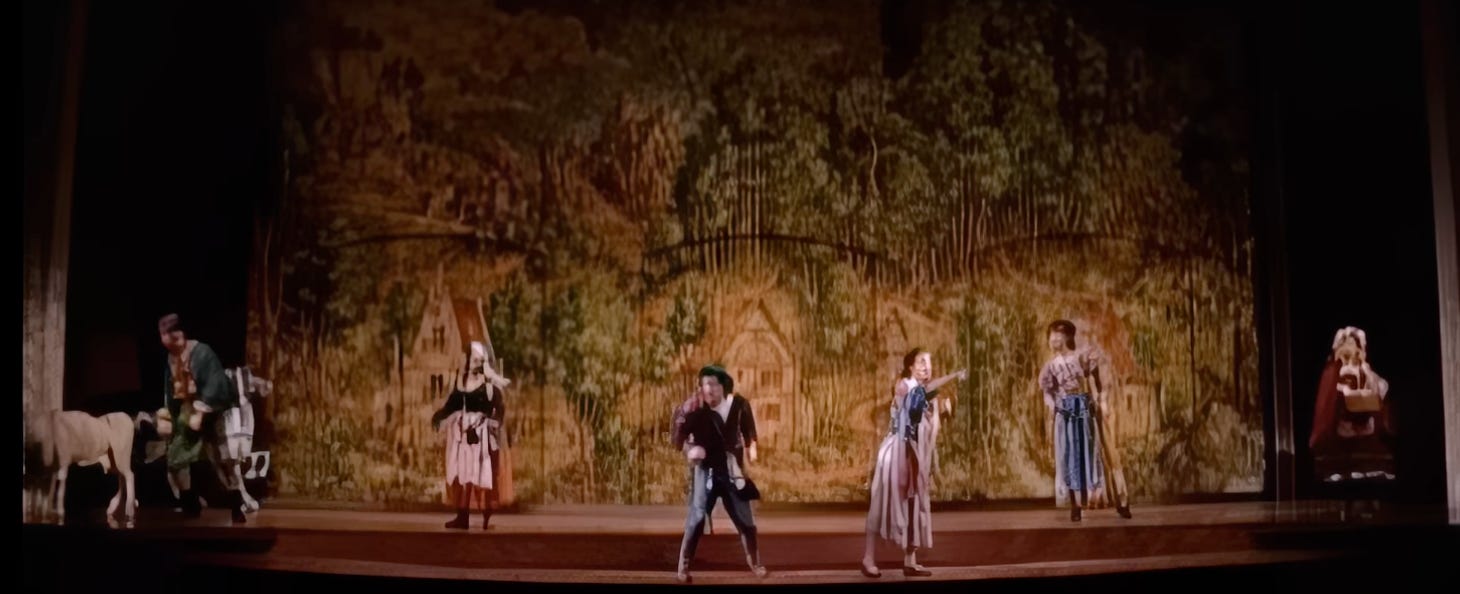
I didn’t really grow up with fairy tales. I wasn’t allowed to watch Disney movies. Pop-feminism at the time when I was growing up dictated that all they taught girls was to want a man to save them. Also my mom was going through a “divorce” so whatever happy endings that may have been latent in her cynic self were well dashed---and so, thus, were any mention of princesses.
Of course I asked about them! I saw the other girls in their nylon Belle dresses, I heard stories of kissing frogs. My mother said, “oh yes! I have just the thing!” and produced Grimm’s Fairy Tales. I asked about Cinderella and got a foot dismemberment.
And then I was given this show.
I got it around the same time I got Company actually. The pro-shoots had both been uploaded to early Netflix that we accessed via the Wii. Company made me think and lust and Into the Woods...
Well it calmed me.
I was home alone for the first time, and I found a story that was beautiful, and if not happy, was very well told. And I like stories. I’ve always liked stories. Complete and complicated. But not too complicated. I was only 10.
And I am not a calm person. My anxiety was intense even then, and my mom saw it as little more than an inconvenience most of the time. She was not a very warm person. She wasn’t good at calming me so I got, well not good, but I had to to calm myself most of the time.
But Into the Woods calmed me.
Maybe it was the repetitive rhymes that felt like a tumble in my mouth. Maybe it was the swish of Kim Crosby’s gown and the sparkle of her tiara. Maybe it was the cord that cut everyone off at the beginning of “Giants in the Sky.”
Maybe it’s because stories are supposed to calm us. The answer to “Just calm the child” is to “Tell him the story/ Of how it all happened.”
And so Sondheim and Lapine told me a story. Usually, a bedtime story. The moral is simple, but the story is twisty. It’s funny, it’s got women in rags and women in gowns. It’s got a fake cow, and a witch who raps! It’s got a little girl who’s precocious, and hey! Just like me.
It’s got parents who complain about their kids like mine complain about me. But it’s also got parents who desperately want a kid. Who get that kid and struggle with wanting him, and still come to the conclusion that they love them even though they don’t know what they are doing. That the kids are important in the end. That morality is hard and there is still love for them. Parents can be complicated and still deep down want their kid. If they seem like they don’t, it’s because they are just so complicated.
And grace can be given to both.
It’s a nice story.
I don’t want to question it.
Company taught me that loving was complicated and worthy of interrogation. Into The Woods reassured me that I could still be loved.
But that was years ago. That’s not still The message. It’s A message.
What resonates now is not what resonated then!
These days... I resonate more with Jack’s “Giants in the Sky” number. Sometimes because I ache to discover somewhere new, sometimes because I am somewhere new and cannot start to express my awe, and sometimes it’s because I’m home and yet homesick for the world I knew before I went away. These days, I resonate with The Baker’s Wife’s strange morality; her “Maybe They’re Really Magic” and “Moment’s in the Woods” and if I deserve her same fate?
And these days, there is both comfort in the finality of and the endless debate of Little Red’s confident assertion that “Nice is different then Good.”
Because what if it is just true? What if we can define morality into one little sentence and live our life in the black and white of right and wrong and black and white and good and bad... and nice and good.
Wouldn’t that be simpler? Wouldn’t that be a nice moral of a fairy tale?
But it isn’t, right?
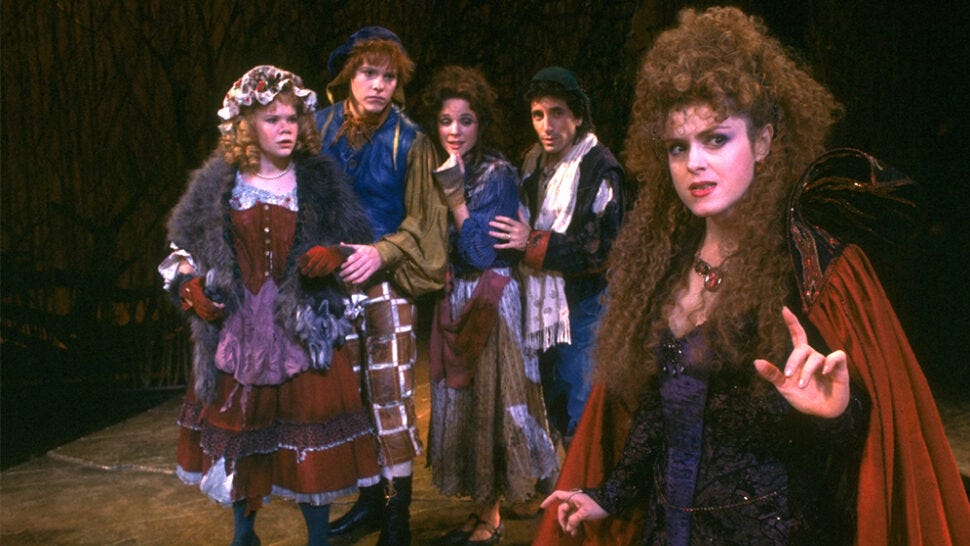
My therapist, the chick from earlier, tells me that I have a habit towards “Black and White Thinking.” It’s a symptom of various mental disorders that they treat with a type of therapy called “Dialectical Behavioral Therapy.” And DBT is a big fan of “walking the middle path.” A dialectic is something that reminds us that “Two things that seem like opposites can both be true.”
And Into the Woods doesn’t disagree with that notion either. “Nice is different than Good“ is a first act message. It’s Little Red’s first conclusion. But, she’s also just a hurt little girl. One that had just been through a traumatic experience. Part of why I have the disorders that make me need DBT therapy is because after trauma it’s very easy to want to search for easy morality. It’s infinitely safer to label people as villains and victims.
But that’s not the final message of Into the Woods. Finally, in “No One is Alone,” the adults take charge and present Jack and Little Red with these dialectics:
You decide alone
But no one is alone
...
Witches can be right
Giants can be good
Dialectic number one: You decide alone vs no one is alone. Dialectic number two: Witches can be right, Giants can be good. The Giant, who initially brought Jack in and gave him food and gave him rest. Whose husband was killed. Who’s a grieving widow.
The great trick of Into The Woods is that it convinces you that it’s a simple fairytale. That in its great complexity there is a single thread you can pull out of it and say this is it! “It’s a fairytale” you tell yourself, “with princes and princesses and giants in the sky!”
But this is a musical by Stephen Sondheim and James Lapine and it’s closer in message to Sunday In the Park With George than one might think. And what I mean by that is that they are both impenetrable messes of brilliant complexity, and you are the one who has to decide what’s good. But you do decide alone.
❤️❤️❤️
I learn from this that although nuance deals in/with subtle differences, there is no shortage of complexity with in those differences... Beautifully written!